
By Carol Gstalder, SVP
KEY TAKEAWAYS
- Origin claims are most believable when consumers understand why a place matters to a product.
- Familiar associations, local expertise, and visible traditions strengthen credibility.
- Evidence such as sourcing details, certification, standards, and traceability helps consumers trust origin claims.
- Places and brands create more value when they connect origin to benefits consumers actually care about.
- Strong origin claims give brands a consistent framework for communicating quality, expertise, and authenticity.
Origin claims can be powerful signals in the marketplace. They help consumers make sense of quality, authenticity, expertise, and tradition. But place only creates value when people understand why it matters.
People want evidence.
Our recent research shows that successful origin claims are grounded in a clear connection between place and product. Consumers are more likely to believe an origin claim when the place is already associated with that product category, when local expertise or traditions are visible, and when brands provide tangible proof through sourcing information, certifications, standards, packaging, or third-party validation.
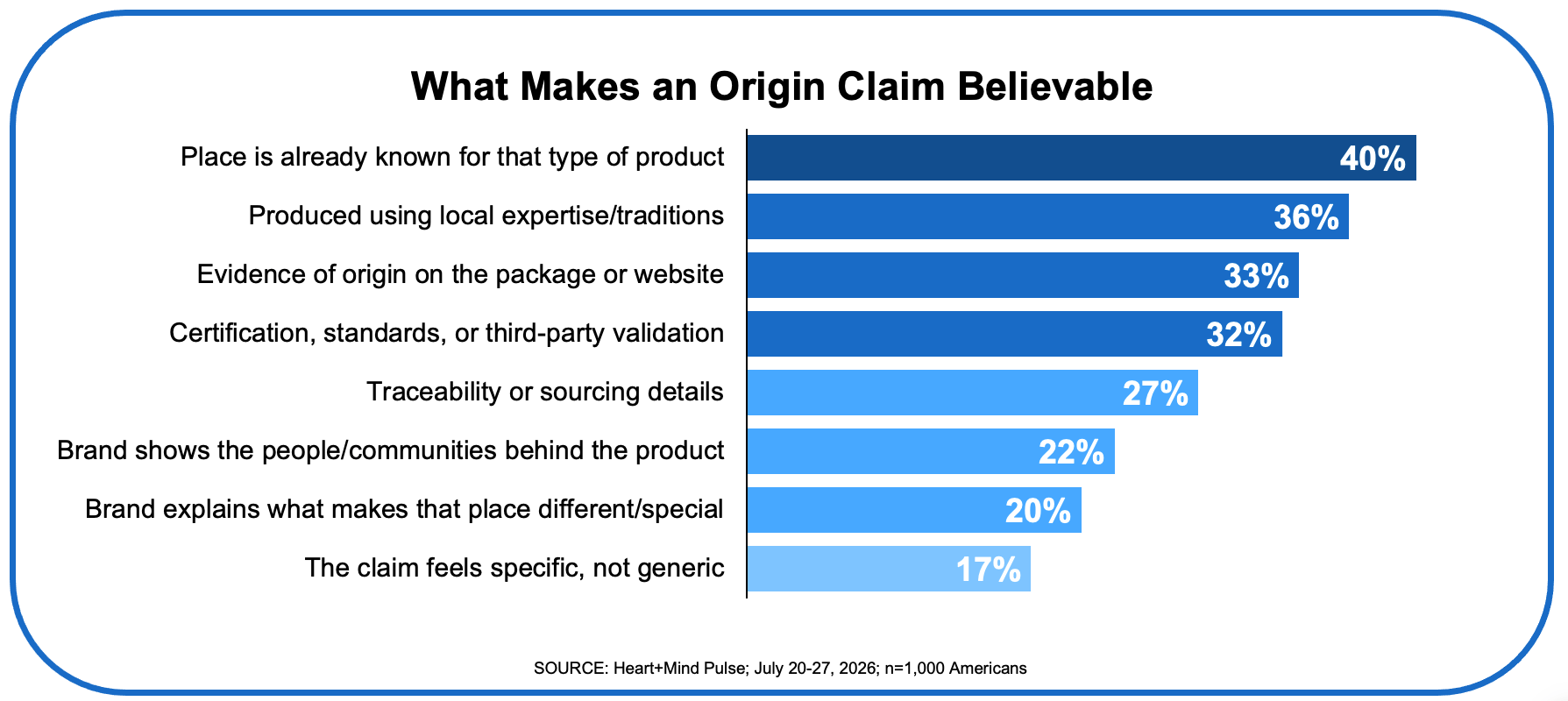
The implication is straightforward: place alone is rarely enough. Consumers need a reason to believe that origin contributes something meaningful, distinctive, and verifiable to the product experience.
What Makes Origin Claims Believable?
Consumers use a combination of signals when evaluating origin claims.
The strongest claims are supported by existing associations. When a place is already known for a particular product, consumers have a mental shortcut that helps them understand why origin matters. A claim rooted in a recognized reputation requires less explanation because the connection already exists.
Local expertise and traditions add another layer of credibility. When consumers can see evidence of specialized knowledge, established practices, or a long-standing connection between a place and a category, the claim becomes easier to believe.
Proof matters because consumers are not just listening to the story. They are looking for signals that help them decide whether the story is credible.
Consumers look for evidence that supports the story. That proof can take many forms:
- Product packaging
- Website sourcing information
- Certification programs
- Quality standards
- Third-party validation
- Supply chain traceability
- Information about producers and communities
The strongest origin strategies make those signals easy to find and easy to understand. They do not rely on one proof point alone; they build a pattern of evidence across the places consumers encounter the brand.
RELATED: Food and Agriculture Organization of the United Nations – Geographical Indications

The Three Elements of a Credible Origin Claim
Our research suggests that the most effective origin strategies connect three ideas clearly.
1. A Credible Reason the Place Matters
The place must have a meaningful connection to the product, category, culture, or experience.
Consumers need to understand why the location deserves attention in the first place. Geographic proximity alone rarely creates value.
2. A Connection to Consumer Value
Origin becomes more relevant when it supports something consumers already care about.
That value may include:
- Product quality
- Expertise
- Craftsmanship
- Authenticity
- Sustainability
- Trust
- Community impact
- Cultural heritage
When the place reinforces those benefits, the claim becomes more persuasive.
3. Proof That Supports the Story
Evidence turns a claim into something people can trust.
Brands that consistently provide sourcing information, certification, standards, traceability, and supporting documentation make it easier for consumers to understand and believe the relationship between place and product.
What This Means for Places of Origin
Regions, countries, destinations, and producer groups often invest heavily in building awareness. But awareness alone does not create marketplace value. Value comes when the awareness is connected to a credible reason to believe, a consumer-relevant benefit, and proof that brands can use consistently.
That means helping brands communicate:
- Specialized expertise
- Local traditions
- Quality standards
- Production methods
- Traceability systems
- Community connections
- Category leadership
The most successful places create a shared language that multiple brands can use to reinforce a common story, while still giving each brand room to express that story in a way that fits its own audience and positioning.

What This Means for Brand Strategy
Origin claims should be treated as strategic brand assets, not marketing slogans.
Brands that successfully leverage origin create a clear bridge between place and consumer value. They provide evidence, communicate consistently, and make it easy for consumers to understand what the place contributes and why that contribution matters.
RELATED: Expertise in Brand Strategy
That approach creates stronger differentiation and greater credibility over time.
Consumers rarely reward unsupported claims. They respond to claims they can understand, evaluate, and trust.
At Heart+Mind Strategies, we help organizations uncover the emotional and rational drivers behind decision-making and translate those insights into more effective brand strategies. Whether you’re evaluating place-based branding opportunities, refining your positioning, or identifying the proof points that strengthen credibility, our team helps connect consumer understanding to business growth.
Connect with the Heart+Mind team to learn how our research and consulting work helps brands build more meaningful and credible market positions.
Frequently Asked Questions
What are origin claims?
Origin claims are messages that connect a product, ingredient, service, or experience to a specific place. They communicate why geographic origin contributes value, quality, expertise, authenticity, or meaning.
Why do origin claims matter?
Origin claims help consumers evaluate products and make decisions. They can serve as signals of quality, expertise, heritage, tradition, or trust when supported by credible evidence.
What makes an origin claim credible?
Consumers are most likely to believe origin claims when the place is already known for the category, when expertise or traditions are visible, and when brands provide proof through sourcing information, certification, standards, traceability, or third-party validation.
How can brands strengthen origin claims?
Brands can strengthen credibility by providing:
- Clear sourcing information
- Certification or standards
- Traceability systems
- Evidence of local expertise
- Information about producers or communities
- Consistent messaging across touchpoints
Can origin claims improve brand performance?
Origin claims can strengthen differentiation when consumers understand how a place contributes meaningful value to the product. The strongest claims connect origin directly to benefits that consumers already care about.
Survey Methodology: The survey consisted of 1,000 online interviews conducted July 20-26, 2026. Respondents for this survey were selected from among those who have volunteered to participate in online surveys and polls.
The data are gathered from one of the largest online panels, which attempts to approximate a cross-section of the U.S. population. To ensure representation of a wide variety of demographic groups, we impose quotas by age, gender, and ethnicity based on U.S. Census data for people aged 18 and older.